
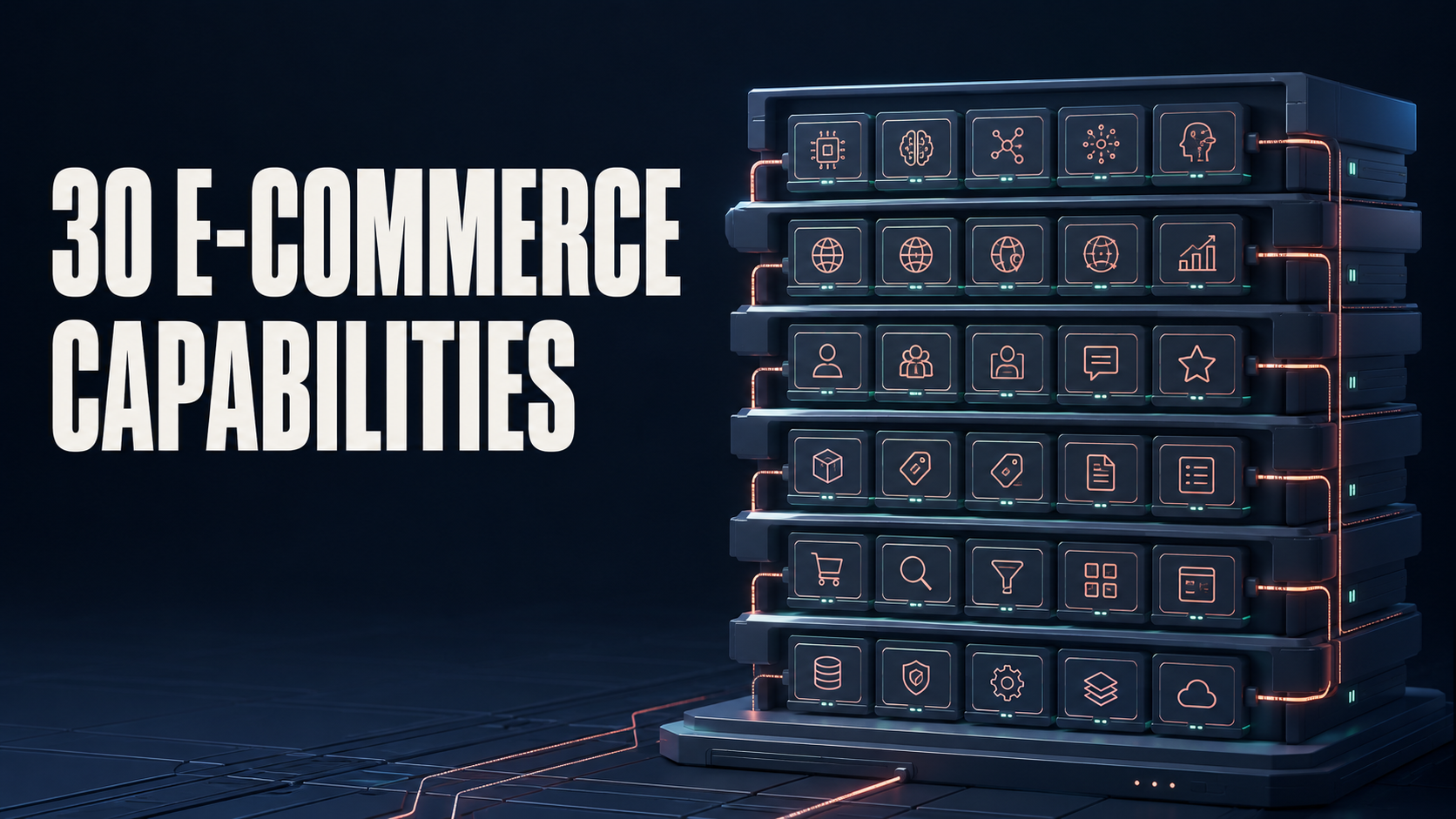
30 E-Commerce Capabilities Worth Planning for in 2026
An online store does not need thirty plugins.
It does need thirty capabilities to be considered.
That distinction matters. A startup store can run catalog, cart, checkout, payments, orders, and basic fulfillment inside one platform. A larger merchant may split those responsibilities across a commerce platform, PIM, OMS, CRM, warehouse system, analytics stack, and several external channels.
Installing a separate app for every item below is how a clean store becomes a plugin zoo: slow pages, duplicated customer data, conflicting discounts, unreliable webhooks, and subscription costs nobody remembers approving.
The better question is:
Which system owns this capability, when is it needed, and how will its data reach the rest of the stack?
This guide organizes thirty e-commerce modules into six architectural layers. Some are launch requirements. Some become important only with volume, multiple channels, international sales, or regulatory exposure.
The 30-module map
| # | Capability | Layer | Typical priority |
|---|---|---|---|
| 1 | Product catalog and PIM | Commerce core | Launch |
| 2 | Search, filtering, and discovery | Commerce core | Launch |
| 3 | Cart and saved state | Commerce core | Launch |
| 4 | Checkout | Commerce core | Launch |
| 5 | Payments and refunds | Commerce core | Launch |
| 6 | Order management | Operations | Launch |
| 7 | Inventory and reservations | Operations | Launch |
| 8 | Shipping, delivery, and tracking | Operations | Launch |
| 9 | Returns, exchanges, and RMA | Operations | Early growth |
| 10 | Tax, invoicing, and fiscalization | Operations | Market-dependent |
| 11 | Customer identity and accounts | Customer | Launch |
| 12 | CRM and customer profile | Customer | Early growth |
| 13 | Customer service and case management | Customer | Launch |
| 14 | Reviews, ratings, and UGC | Customer | Early growth |
| 15 | Lifecycle, loyalty, and retention | Customer | Early growth |
| 16 | SEO, structured data, and feeds | Growth | Launch |
| 17 | Promotions, coupons, and pricing rules | Growth | Launch |
| 18 | Merchandising and recommendations | Growth | Early growth |
| 19 | Marketplaces and social channels | Growth | Conditional |
| 20 | Analytics, attribution, and experiments | Growth | Launch |
| 21 | Security and access control | Control | Launch |
| 22 | Fraud, chargebacks, and abuse prevention | Control | Launch |
| 23 | Privacy, consent, and data lifecycle | Control | Market-dependent |
| 24 | Accessibility | Control | Launch |
| 25 | Monitoring, audit logs, and incident response | Control | Launch |
| 26 | Localization and multi-currency | Scale | Conditional |
| 27 | Product safety and compliance data | Scale | Market-dependent |
| 28 | Supplier and procurement management | Scale | Conditional |
| 29 | Integration and event layer | Scale | Early growth |
| 30 | AI operations and agentic commerce | Scale | Experimental |
“Launch” does not always mean a separate module. It means the capability must have an explicit owner before accepting orders.
Layer 1: commerce core
These five capabilities form the transaction path. They should usually remain close to the main commerce platform because instability here directly blocks revenue.
1. Product catalog and PIM
The catalog stores products, variants, identifiers, attributes, media, prices, availability rules, and relationships between items. A small store can use the platform’s native catalog. A multi-market or multi-supplier merchant may eventually need product information management.
The key architectural decision is the source of truth. If price changes in the ERP, descriptions live in WordPress, and stock is edited manually in three marketplaces, the “catalog module” is already a distributed system—just an uncontrolled one.
2. Search, filtering, and discovery
Search should understand product language, misspellings, synonyms, categories, and availability. Filtering must use structured attributes rather than values buried in descriptions.
The priority depends on assortment size. A store with twelve products may need good navigation, not an expensive AI search service. A store with twenty thousand variants cannot treat discovery as a decorative search box.
3. Cart and saved state
The cart owns line items, quantities, variants, bundles, discounts, and the customer’s current purchase context. It must survive normal navigation and should behave predictably across devices when the buyer is identified.
Complexity appears with subscriptions, bundles, gifts, preorders, multiple sellers, split shipments, or several currencies. Each rule added to the cart must remain compatible with checkout, inventory, and refunds.
4. Checkout
Checkout validates customer details, shipping eligibility, tax, inventory, discounts, and the final payable amount. It should minimize friction without hiding consequential information.
Do not turn checkout into an experimentation playground. A stable native checkout with supported extensions is usually safer than a heavily customized flow that breaks after platform or payment updates.
5. Payments and refunds
This capability covers authorization, capture, partial capture, refunds, failed payments, alternative methods, reconciliation identifiers, and dispute evidence.
Use hosted or platform-supported payment components where practical to reduce exposure to card data. PCI DSS provides the baseline for protecting payment account data, and current requirements include controls around payment-page scripts and tampering.
Layer 2: order and fulfillment operations
The storefront promises. Operations must deliver that promise while preserving a reliable order history.
6. Order management
An order management system tracks the order from creation through payment, allocation, fulfillment, cancellation, return, and refund. One visible “status” is rarely enough; payment, fulfillment, customer communication, and accounting may each have separate states.
The module should preserve history rather than overwrite it. Support teams need to know what happened, when it happened, and which system initiated the change.
7. Inventory and reservations
Inventory is not merely a number on a product page. A serious module distinguishes physical stock, available-to-sell quantity, reservations, incoming supply, damaged items, and stock assigned to different locations or channels.
The critical rule is ownership. Choose the authoritative inventory system and make other channels consume its state. Two systems independently “correcting” stock will eventually oversell or hide available units.
8. Shipping, delivery, and tracking
This capability calculates available methods, rates, delivery windows, labels, tracking events, pickup points, and failed-delivery actions. A useful promise is based on destination, inventory location, cutoff time, carrier service, and handling capacity—not a static “2–3 days” banner.
Tracking events should update the order and trigger communication without creating duplicate messages from the store, carrier, marketplace, and CRM.
9. Returns, exchanges, and RMA
Returns need eligibility rules, reason codes, labels or routing, inspection, refund decisions, exchange inventory, and recovery of the returned item. The module becomes financially important long before it feels technologically interesting.
Track return rates by SKU, variant, supplier, acquisition source, and reason. “Didn’t fit” and “not as described” are product-data signals, not only support outcomes.
10. Tax, invoicing, and fiscalization
This layer determines applicable tax, generates legally valid documents, handles credit notes, and connects to country-specific fiscal or accounting systems where required.
Tax and invoice rules should not be approximated from blog posts. Markets differ, regulations change, and a payment receipt is not automatically a compliant invoice or fiscal receipt.
Layer 3: customer and retention
These modules turn anonymous sessions and orders into an understandable customer relationship.
11. Customer identity and accounts
Identity includes guest checkout, account registration, authentication, password recovery, addresses, preferences, and order access. Avoid forcing registration before purchase unless the business model genuinely requires it.
Accounts must not expose orders through predictable identifiers or weak verification. Convenience cannot come at the cost of account takeover or personal-data leakage.
12. CRM and unified customer profile
A customer profile may combine identity, orders, support history, consent, loyalty state, and relevant behavioral signals. “Unified” does not mean copying every event into every tool.
Define which system owns identity and which systems are allowed to update important fields. Merge rules matter: duplicate profiles can produce conflicting communications and misleading lifetime-value calculations.
13. Customer service and case management
Support should connect email, chat, forms, marketplace messages, and order context into cases with ownership and history. A chat widget without order visibility is a conversation channel, not a support system.
Useful automation gathers evidence, classifies the issue, and drafts a response. Refunds, replacements, safety complaints, and legal requests still need rules and escalation.
14. Reviews, ratings, and user-generated content
Reviews provide social proof and product feedback. The system should connect reviews to real products, moderate abuse, support media where useful, and distinguish verified purchases without presenting the label as proof that every claim is true.
Do not duplicate reviews across several apps. Decide how they are stored, syndicated, exported, and preserved if the provider changes.
15. Lifecycle, loyalty, and retention
This includes transactional messages, replenishment reminders, post-purchase education, loyalty rules, subscriptions, referrals, win-back flows, and customer-specific offers.
Begin with lifecycle events that help the customer. A points program does not create loyalty when delivery is unreliable or returns are painful.
Layer 4: growth and merchandising
Growth modules should improve discovery and decisions without corrupting the core transaction logic.
16. SEO, structured data, and product feeds
This capability controls crawlable categories and products, canonical URLs, metadata, sitemaps, product variants, availability, shipping, returns, and feeds to search or shopping platforms.
Google can combine on-page product structured data with Merchant Center data. If price or stock differs between the site and feed, distribution becomes unreliable. Feed freshness is an operational concern, not merely an SEO task.
For the broader search layer, see How Important Is SEO for E-Commerce in 2026.
17. Promotions, coupons, and pricing rules
Promotions may include fixed or percentage discounts, bundles, gifts, tiered pricing, customer groups, channel-specific prices, and time windows. The module must define stacking, exclusions, rounding, refunds, and how discounts appear in accounting.
If two tools can both modify the same cart price, test every interaction. “Twenty percent off” sounds simple until it meets a bundle, gift card, VAT, partial refund, and marketplace commission.
18. Merchandising and recommendations
Merchandising controls collection order, badges, related products, cross-sells, substitutes, and recommendations. Start with explainable business rules before adding opaque personalization.
Recommendations should respect availability, margin, compatibility, and context. Suggesting an unavailable or incompatible product is worse than showing nothing.
19. Marketplace and social-channel syndication
This capability publishes products to marketplaces, social platforms, AI shopping surfaces, and comparison services, then returns orders and status changes to the operating stack.
The difficult part is not exporting a CSV. It is mapping categories, attributes, prices, stock, fees, cancellations, messages, and returns without losing channel attribution. The discovery trade-offs are explored in Mastering Cross-Platform Social Commerce.
20. Analytics, attribution, and experimentation
Analytics should connect sessions, campaigns, carts, orders, refunds, contribution margin, and repeat purchase. Revenue alone hides discounts, channel fees, shipping, returns, and fraud.
Experimentation needs a decision rule and enough traffic. Small stores often learn more from ten customer interviews and checkout recordings than from an underpowered A/B test.
Layer 5: control, trust, and resilience
These capabilities rarely appear in store mockups, but they determine whether the business can operate safely and recover from failure.
21. Security and access control
Security includes authentication, multifactor access, least-privilege roles, session management, dependency updates, secret handling, and administrative auditability.
User roles are not a convenience module. A marketer, warehouse operator, developer, accountant, and support agent should not all share one administrator account.
22. Fraud, chargebacks, and abuse prevention
Fraud controls evaluate payment, account, device, address, velocity, promotion abuse, return history, and order patterns. The goal is not maximum rejection; it is reducing loss without blocking legitimate customers.
Keep the evidence needed for disputes and measure false positives. A fraud tool that silently rejects valuable orders can be expensive while appearing successful.
23. Privacy, consent, and data lifecycle
This capability records consent, controls marketing eligibility, fulfills access or deletion requests, applies retention rules, and manages data passed to analytics and advertising systems.
A cookie banner is not a privacy system. The underlying tags, exports, backups, and vendors must follow the captured choices and the applicable legal basis.
24. Accessibility
Accessibility covers keyboard navigation, semantics, contrast, labels, error messages, focus management, media alternatives, and assistive-technology compatibility across discovery and checkout.
It is a product-quality requirement, not a cosmetic overlay. The European Accessibility Act now explicitly covers e-commerce services in the EU, subject to its scope and national implementation.
25. Monitoring, audit logs, and incident response
Monitoring should detect failed payments, broken webhooks, feed errors, inventory drift, stuck orders, carrier failures, elevated refunds, and frontend degradation. Audit logs answer who changed price, status, access, or configuration.
Alerts need owners and runbooks. A dashboard nobody checks is decoration. The full order chain is discussed in From Sign-Up to Delivery: A Guide to E-Commerce Operations.
Layer 6: scale, markets, and automation
These modules become important when the store adds regions, suppliers, channels, or enough volume that manual coordination begins to fail.
26. Localization and multi-currency
Localization includes language, currency, units, address formats, payment methods, taxes, delivery options, policies, and market-specific catalog eligibility.
Translation alone can create a store that attracts international orders but cannot fulfill or return them economically. Cross-border payment complexity is examined in Future Payment Horizons.
27. Product safety and compliance data
The store may need responsible-party details, warnings, origin, materials, conformity documents, recall handling, repair information, or Digital Product Passport data depending on category and market.
Compliance data should be connected to the product record and sales channel. It cannot remain scattered across supplier PDFs when marketplaces and regulators require structured, current information.
28. Supplier and procurement management
This capability manages supplier records, purchase orders, lead times, costs, minimum quantities, incoming inventory, quality issues, and replenishment decisions.
It becomes valuable when a merchant must answer not only “what is in stock?” but “when should we reorder, from whom, at what landed cost, and what demand was lost during stockouts?”
29. Integration and event layer
The integration layer moves products, customers, orders, payments, documents, stock, and status changes between systems. It may consist of native connectors, an automation platform, queues, middleware, or custom services.
Every integration needs field ownership, idempotency, retries, logs, rate-limit handling, and reconciliation. Moving data once is a script. Keeping two systems consistent for years is an operating capability.
30. AI operations and agentic commerce
AI can classify support requests, extract product attributes, identify anomalies, summarize supplier changes, or prepare resolutions for stuck orders. Shopping agents can increasingly search catalogs, build carts, and initiate checkout through structured commerce interfaces.
AI should not become an unaudited source of price, inventory, tax, or refund truth. Use the pattern:
event → deterministic checks → AI interpretation → confidence threshold → action or human review → logged outcome
The architectural shift behind this module is covered in 6 E-Commerce Shifts That Actually Matter in 2026.
What the minimum stack looks like by stage
Not every business needs every module on day one.
Stage 1: validating demand
Use one managed platform for catalog, cart, checkout, payment, orders, basic inventory, shipping, tax configuration, customer communication, analytics, and security.
Add only what fixes a measured problem. A founder testing twelve products does not need a PIM, recommendation engine, warehouse system, or customer data platform.
Stage 2: repeatable operations
Introduce structured support, returns, lifecycle communication, better analytics, feed management, monitoring, and an integration layer. Document which system owns products, customers, inventory, and order states.
This is also the moment to inspect the real cost stack. Investing in Digital Commerce covers the expenses hidden behind the storefront.
Stage 3: multiple channels or locations
Add an OMS or stronger inventory layer when allocation and reservations exceed the platform’s native model. Centralize product data, reconcile channel fees, and stop relying on manual exports.
Unsold and aging stock deserve their own workflow; see What Retail Stores Do With Inventory That Doesn’t Sell.
Stage 4: cross-border or regulated scale
Add market-specific tax, invoicing, localization, product safety, privacy, accessibility, responsible-party data, and stronger audit controls. Test the entire order-and-return loop in each market before scaling acquisition.
Five rules for avoiding the plugin zoo
One owner per critical entity
Products, stock, customers, orders, payments, and invoices need authoritative systems. Other tools may enrich or consume the data, but ownership must be explicit.
Prefer native transaction paths
Keep cart, checkout, payment, and core order creation close to the commerce platform. Customize around the edges unless the business model genuinely requires a different core.
Integrate through events, not memory
Important state changes should emit events, trigger controlled workflows, and remain observable. Manual “remember to export this every Friday” processes do not scale safely.
Measure total operational cost
Include subscription, implementation, maintenance, page-speed impact, support time, failure recovery, and switching cost. A $20 app can create a $2,000 monthly operational dependency.
Delete before adding
When two tools overlap, consolidate. Fewer systems with clear ownership usually outperform a larger stack with clever features and ambiguous data.
What changed from the original module list
The 2023 version mixed features, system qualities, and integrations in one flat list. It also promised twenty modules in the introduction, listed thirty, and duplicated product reviews.
Several items have been reframed:
- Mobile responsiveness is now a baseline quality requirement, not a plugin.
- Security has become a complete control layer with roles, audit, fraud, and payment-page integrity.
- SEO now includes structured product data and feed consistency.
- Multi-language and currency are part of market-specific localization.
- Reviews appear once, with ownership and portability.
- Wishlist, gift cards, referrals, comparisons, and live chat remain useful optional features inside broader capabilities—not universal modules.
- Observability, accessibility, integration architecture, product compliance, and AI operations have been added because modern commerce depends on them.
Final takeaway: design capabilities, not a collection of apps
A successful e-commerce stack is not the store with the most modules. It is the store where every important capability has:
- a clear business reason;
- one responsible owner;
- an authoritative data source;
- defined inputs and outputs;
- measurable success criteria;
- monitoring and a recovery path;
- a plan for removal or replacement.
Start with the transaction path. Add operational control. Expose the real economics. Expand channels and automation only when the core data can survive them.
The goal is not to install thirty things. It is to prevent the thirtieth thing from breaking the first five.