
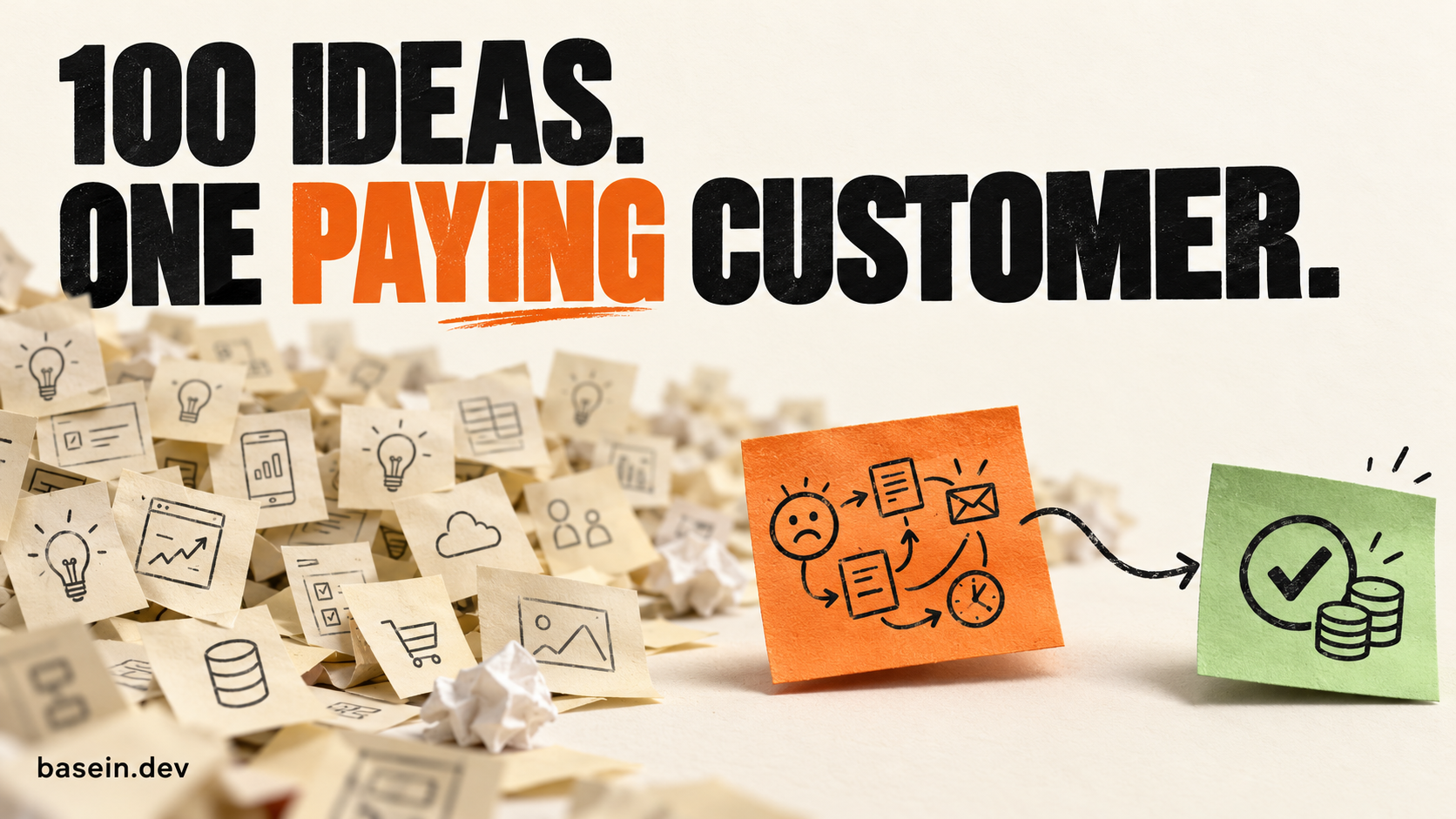
You can ask an AI assistant for a hundred online business ideas and get a list before your coffee cools down.
That still leaves the difficult questions unanswered. Who needs one of those products? How do you reach them? What are they doing instead? And would they pay enough to make the business worth running?
My approach is to treat inspiration as a starting point for research. Look for a recurring problem, a reachable buyer, and a small solution you can test.
You do not need to imagine an entirely new market. Sometimes the opportunity is a spreadsheet someone updates every Friday, an integration that keeps breaking, or a useful resource nobody maintains.
1. Start with work you already understand
Your interests can give you the energy to keep going. Your experience helps you notice what other people miss.
Think about the workflows you have seen from the inside:
- What do people repeatedly copy between systems?
- Which reports take hours to prepare but minutes to read?
- What keeps generating support requests?
- Where does someone check the same information every day?
- Which task depends on one person remembering to do it?
A broad idea might be “build an e-commerce tool.” A more useful observation is “a merchant discovers failed stock updates only after accepting orders.”
The second version identifies an event, a consequence, and a possible buyer. You can investigate it before writing code.
Keep a problem log. Record who encounters the problem, when it happens, what they do now, and what failure costs them. Leave the proposed solution blank until you understand the workflow.
2. Research workarounds, complaints, and existing spending
A complaint is a clue. A recurring workaround deserves a closer look.
Read product reviews, support forums, professional communities, and marketplace listings. Look for descriptions such as:
- “We export everything and fix it in a spreadsheet.”
- “The feature exists, but only in the expensive plan.”
- “We hired someone to check this manually.”
- “It works until an order contains…”
- “I need this for one country, platform, or industry.”
Follow the complaint into the underlying task. Someone asking for a dashboard might really need a warning when something goes wrong.
Record the source, date, customer type, workaround, and any evidence of spending. Several complaints may describe the same incident or come from people outside your intended market, so count independent examples carefully.
Existing spending is useful evidence: the customer already allocates money or staff time to the problem. It still does not prove they will buy your particular solution.
3. Use trends to generate questions
Google Trends can help you compare search interest over time and across regions. Its scores represent relative interest, normalized for the selected time and location; they are not absolute search volumes or sales figures. Low-volume terms can also appear as zero. [1]
Use that information to investigate questions:
- Is attention sustained or tied to one news event?
- Does demand appear seasonal?
- Are people researching a problem, comparing products, or trying to buy?
- Is the relevant audience concentrated in a market you can serve?
Search for language around action: “alternative,” “migration,” “export,” “integration,” or “service.” Then inspect the results and talk to potential buyers.
An obscure B2B workflow may have little visible search activity and still support a small business. A popular topic may attract an audience with no intention of buying anything.
4. Look for gaps inside existing markets
Competition gives you something concrete to study: offers, pricing structures, customer expectations, and complaints.
Avoid defining the opportunity as “the same product, but cheaper.” Check whether you can serve a narrower customer or complete one neglected task.
For example:
| Broad market | Narrow problem to investigate |
|---|---|
| CRM software | Finding failed data transfers between a CRM and accounting system |
| Business directories | Maintaining a verified list of suppliers in one niche |
| Reporting software | Producing a monthly report required by one type of client |
| E-commerce automation | Checking whether marketplace feeds contain outdated stock |
These are research directions, not validated business ideas.
A useful positioning sentence is: “For [specific customer], we help complete [specific task] when [specific situation occurs].”
If the sentence needs five audiences and ten features, narrow it.
5. Use AI to organize evidence
AI can help you group interview notes, compare complaints, generate research questions, and explore possible offers.
Give it source material and clear boundaries. For example:
Review these anonymized interview notes. Group recurring problems by customer type, frequency, consequence, and current workaround. Attach the relevant note IDs to every finding. Separate explicit statements from your inferences. Mark missing information as unknown.
Then check the output against the originals. Remove personal information and confidential business data before using material in a tool unless you have permission and appropriate data handling arrangements.
Be especially careful with questions such as “Is this a profitable niche?” A fluent answer can turn assumptions into something that sounds like evidence.
Ask AI to identify what you still need to learn. Get the answers from customers, actual usage, costs, and payment decisions.
6. Talk about the last time the problem happened
General enthusiasm is easy to get. Specific accounts are more useful.
Y Combinator’s guidance on talking to users is a useful starting point for planning interviews and interpreting feedback. [2] For your own research, focus on recent behavior:
- When did this last happen?
- Can you walk me through what you did?
- How often does it happen?
- What was delayed, lost, or put at risk?
- Have you paid for a workaround?
- Who would approve a purchase?
- What would make switching difficult?
Avoid spending the whole conversation pitching your solution. You need enough detail to discover that your first interpretation might be wrong.
A person who likes the idea, a person who uses it, and a person who controls the budget may be three different people.
7. Pick the smallest offer that delivers an outcome
A software subscription is only one possible business model.
Your first offer could be a fixed-scope service, a maintained dataset, a paid report, a template with setup help, or a small monitoring tool.
Consider a merchant who needs reliable stock synchronization. The first paid offer might be an audit and weekly exception report. Delivering that manually can reveal which checks repeat and which require judgment.
That knowledge helps you decide what to automate.
Similarly, a niche directory might begin as a manually verified shortlist. A reporting product might begin as a spreadsheet and a monthly service.
Manual delivery is useful when it tests the core outcome. It becomes misleading if the service depends on expensive personal effort that customers will never pay enough to cover.
8. Test commitment before expanding the build
Different responses answer different questions.
| Response | What it helps establish |
|---|---|
| “Interesting idea” | The concept attracts some attention |
| A detailed account of a recent problem | The problem exists for that person |
| Agreement to a trial with time or data invested | They are willing to make some effort |
| A paid pilot | One buyer accepts a defined offer at a stated price |
| Renewal or repeat purchase | The outcome has continuing value for that buyer |
None of these alone proves a scalable market.
Make the test concrete: one customer type, one promised outcome, a price, a delivery date, and a clear scope. If you take payment before delivery, explain what exists, what remains to be built, and the cancellation or refund terms.
A landing page and waiting list can test messaging. Payment and delivery teach you about the business.
9. Check distribution and the cost of running it
Before building, write down how you will reach the first ten plausible buyers.
“SEO” is too broad. A tutorial answering a specific migration question is a testable route. So is a partnership with an agency already serving the customer, or a useful contribution to a professional community where promotion is permitted.
Then estimate the operating work:
- Onboarding and data cleanup
- Support and exception handling
- Hosting, APIs, payment fees, and refunds
- Maintenance when external systems change
- Customer acquisition and cancellations
For illustration, 20 customers paying $25 per month produce $500 in monthly revenue. If each needs an hour of support, that is 20 hours of support before development, administration, or costs.
Those numbers describe a hypothetical scenario. Build your own estimate, then replace assumptions with pilot data.
A small digital asset is attractive when the value delivered can grow faster than the work required to maintain it.
A seven-day plan to test one idea
Treat this as a research sprint, not a deadline for proving a business.
Day 1: Choose one customer group you understand or can access.
Day 2: Collect ten concrete examples of problems. Keep sources and dates.
Day 3: Group the examples and choose one recurring task to investigate.
Day 4: Speak with potential users about recent incidents and workarounds.
Day 5: Write one offer with a defined outcome, scope, price, and delivery date.
Day 6: Present it to relevant prospects. Record questions, objections, and commitments.
Day 7: Review what changed in your understanding. Continue, revise the offer, investigate further, or stop.
Ten examples and a few conversations are a starting sample. Difficult access, longer sales cycles, or conflicting evidence may require more research.
The useful result is a clearer decision about your next investment of time.
What to look for next
The most promising idea may sound mundane when you describe it: fewer broken imports, a faster report, a maintained list, an alert that arrives before a customer complains.
Start there. Learn who owns the problem, how they handle it, and what a better outcome is worth.
Then make a small offer and see what happens when someone has to choose.
Which task are people around you already spending time or money to work around?