
I recently started looking at open-source software from a commercial angle. Not simply as free replacements for paid tools, but as machines that can produce something customers will pay for.
Blender can produce models, renders, and product visualizations. Krita can produce illustrations and design assets. Godot can produce games—but games may be only the most obvious output.
What else could be built with a free, commercially usable game engine?
One possibility keeps returning to me: a web platform where people can operate a simulated business, make decisions, deal with interruptions, and see the consequences unfold over time.
Not another business course. Not a spreadsheet with a fictional profit-and-loss statement. Not a game that compresses five years of company history into twenty minutes.
A living operational simulation.
The first version could be a hotel.
The Product Idea
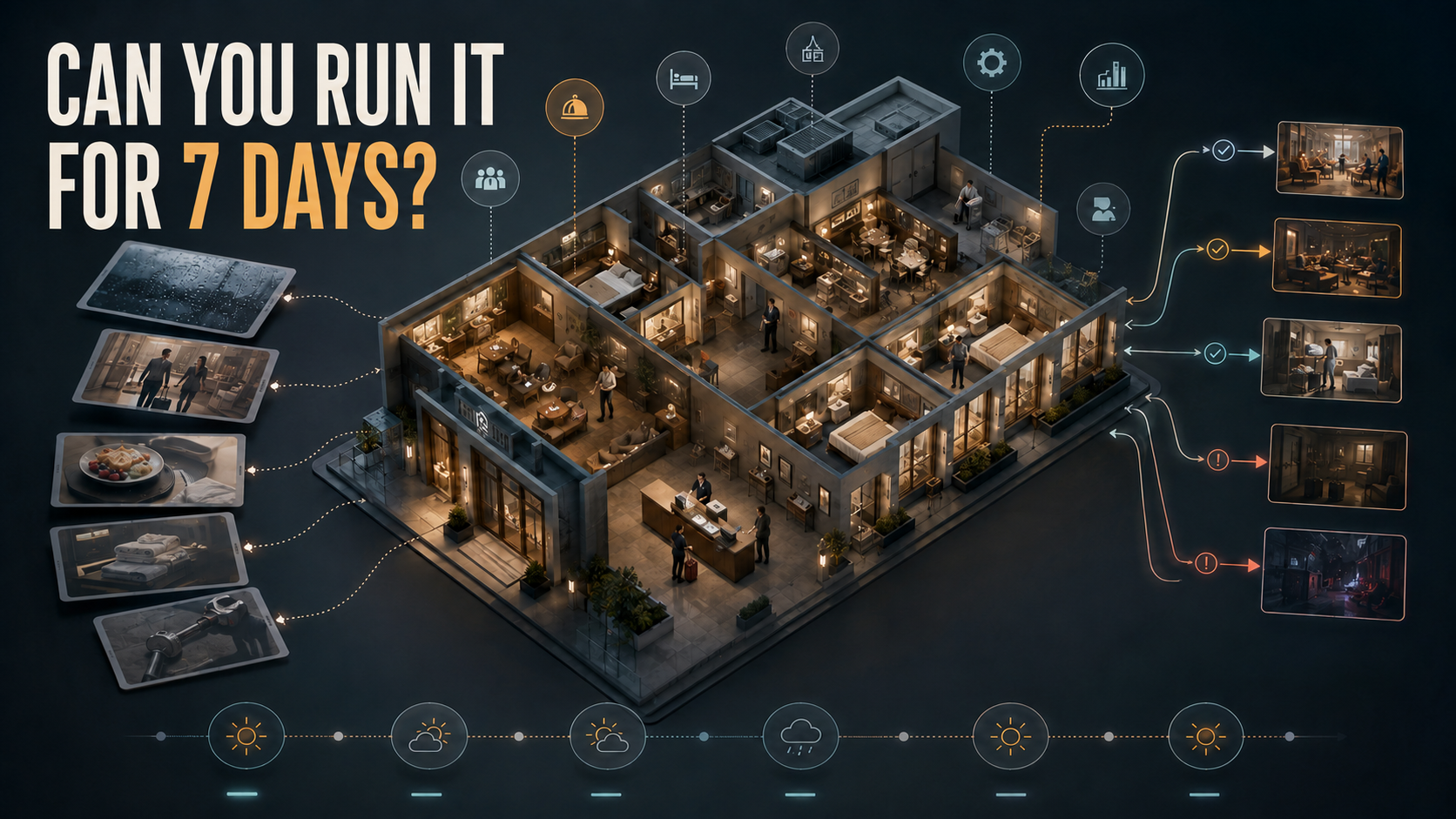
Imagine signing into a browser application on Monday morning and becoming the manager of a small 24-room hotel.
The hotel already has bookings, staff schedules, cash reserves, reviews, maintenance problems, and a few unresolved guest requests. The player has to decide what to do first.
During the day, new events arrive:
- A guest requests an early check-in, but no clean room is available.
- A receptionist calls in sick before the evening shift.
- A booking platform changes a reservation.
- The water heater begins behaving suspiciously.
- A corporate group asks for a discount.
- A negative review appears after a communication failure.
- The housekeeping budget is already above plan.
- A supplier offers a lower price in exchange for a longer contract.
Every decision affects several connected variables: cash, occupancy, guest satisfaction, staff morale, operational risk, and the manager’s remaining time.
The important twist is that the simulation does not need to end in one sitting. It could run for five or seven real days. The system sends occasional events by email, Telegram, or browser notification. The participant has a limited period in which to respond.
This creates something closer to management than a conventional game. Real managers rarely receive a complete problem with four neatly labeled answers. Problems arrive at inconvenient times, interact with one another, and punish neglected trade-offs.
Why Stretch the Simulation Across a Week?
Most simulations test whether someone can choose a plausible answer while fully focused on the exercise. A multi-day format can test something more valuable: how a person manages incomplete information, competing priorities, delayed consequences, and accumulated decisions.
On Tuesday, reducing housekeeping hours may look like an easy saving. On Thursday, room availability falls because cleaning takes longer. On Friday, an important group arrives while several rooms are still unavailable.
The player should not be told immediately whether every choice was correct. Some consequences should appear later. That delay is what turns a quiz into a system.
A week-long simulation could measure:
- response time;
- prioritization;
- consistency between decisions;
- willingness to escalate;
- financial judgment;
- treatment of customers and employees;
- ability to detect weak signals;
- performance under a growing operational backlog.
It also makes the experience more memorable. Instead of completing “Module 4: Conflict Resolution,” the participant remembers the Thursday when a boiler failure, an angry guest, and a missing receptionist arrived within the same hour.
There Is Already a Market—but There May Be a Gap
Business simulation is not a new category. Platforms such as Capsim, Cesim, Unstop, SimInsights, and Gamelearn already offer simulations for strategy, operations, finance, leadership, recruitment, and soft skills.
An overview published by Unstop identifies the expected features of this market: scenario modelling, decision-making, performance tracking, visualization, reporting, customization, integrations, and support for different devices. It also shows that existing providers frequently position themselves as broad learning or assessment platforms.
That validates the category, but it does not automatically validate this product.
The possible opening is narrower: operational simulations for specific small and medium-sized businesses, delivered through a simple browser interface and designed to continue asynchronously over several days.
Instead of promising to teach “business strategy,” the product could promise something concrete:
Run a small hotel for seven days and discover how you handle staff, guests, cash, and operational incidents.
Specificity makes the product easier to understand, demonstrate, and evaluate.
Why Start With a Hotel?
A hotel is a useful first simulation because it combines several business systems that ordinary users immediately understand:
- inventory in the form of rooms;
- capacity that expires every night;
- variable pricing;
- staff scheduling;
- customer service;
- maintenance;
- reviews and reputation;
- supplier relationships;
- direct sales and marketplace-like booking channels;
- emergencies and unexpected arrivals.
It is complex enough to produce interesting decisions but familiar enough that the player does not need twenty pages of instructions.
The simulation could begin with a small independent property rather than a large resort. Twenty-four rooms, a reception desk, a housekeeping team, one maintenance contractor, a breakfast service, and two major booking channels are enough to create dozens of meaningful scenarios.
It also creates several potential audiences.
Aspiring hotel owners could use it to understand the operational reality before investing money. Hospitality schools could use it as a practical exercise. Hotel groups could use customized scenarios for onboarding. Recruitment teams could use it to observe candidates for front-desk or junior management positions.
One simulation engine, several different products.
The HR Use Case May Be More Valuable Than the Consumer Game
Consumers may pay for an interesting “run a hotel” experience. Companies may pay considerably more if the same system helps them make better hiring or training decisions.
A résumé says that a candidate is organized, customer-focused, and comfortable under pressure. A simulation can generate behavioral evidence.
For example, two candidates may finish with similar financial results but take very different paths. One protects short-term revenue while allowing staff morale to collapse. Another communicates well but escalates every unusual situation. A third notices patterns early and prevents incidents before they become expensive.
The HR dashboard could show more than a final score:
- which information the candidate opened before deciding;
- how long important events remained unanswered;
- whether the candidate changed a decision after receiving new evidence;
- which trade-offs were repeatedly favored;
- whether customer, staff, safety, or profit metrics dominated their choices;
- how performance changed as the event queue became more complicated.
This is potentially useful for recruitment, but it introduces an important responsibility. The system should not claim to determine who is a “good employee.” It can provide structured observations related to a specific role, while the employer remains responsible for the hiring decision. Scenarios would need testing for relevance, accessibility, and unintended bias.
That makes the safest initial positioning training and development, with candidate assessment introduced only after the scenarios produce reliable and explainable results.
One Engine, Many Businesses
The hotel should be a vertical product, but the underlying system can be horizontal.
At its core, every simulated business contains similar components:
- resources;
- employees and roles;
- customers;
- inventory or capacity;
- recurring costs;
- incoming events;
- decisions;
- delayed consequences;
- business metrics;
- rules connecting everything together.
Replace rooms with warehouse locations and guests with orders, and the same engine becomes an e-commerce fulfilment simulation. Replace rooms with service bays and guests with vehicles, and it becomes an auto repair business. Replace them with tables, ingredients, and diners, and it becomes a restaurant.
Possible future verticals include:
- an online store handling orders, returns, stockouts, and marketplace failures;
- a warehouse balancing speed, accuracy, labour, and delivery deadlines;
- a restaurant dealing with reservations, spoilage, staffing, and reviews;
- a small clinic managing appointments, queues, privacy, and service quality;
- a property-management company responding to tenants and contractors;
- an agency allocating people across clients, deadlines, and incidents;
- a repair shop coordinating diagnostics, parts, technicians, and customer expectations.
The reusable asset is not any one graphical environment. It is the event-and-consequence engine, scenario editor, scoring model, notification system, and analytics layer.
Why Use Godot?
Godot is released under the MIT license, permits commercial use, and does not impose engine royalties on the content created with it. That makes it attractive for experiments where the business model is not yet proven.
It can provide the interactive layer: the hotel dashboard, room map, animated events, characters, conversations, and visual feedback. A project can also be exported for the web, allowing participants to enter through a link without installing a traditional game.
Godot should not, however, run the entire week-long simulation inside an open browser tab. Browsers can pause inactive tabs, and local persistence is not sufficient for a serious HR or training product. The authoritative simulation state, event schedule, accounts, and reporting should live on a conventional backend. Godot becomes the interactive client, while the server continues the business clock and delivers new events.
The architecture could look like this:
- A web backend stores users, organizations, scenarios, decisions, and results.
- A scheduler activates events according to simulation time and previous choices.
- Godot renders the interactive business and submits player decisions through an API.
- Email, Telegram, or push notifications bring the participant back when attention is required.
- A conventional web dashboard allows facilitators or HR teams to configure sessions and review results.
For the first prototype, Godot may not even be necessary everywhere. Administration and reporting are better suited to an ordinary web application. Godot earns its place where interactivity and a sense of operating a real system matter.
What the First MVP Could Contain
The temptation would be to build a detailed hotel with floors, rooms, guests walking through corridors, and an AI receptionist. That would be visually impressive and commercially premature.
A useful MVP could be much smaller:
- one 24-room hotel;
- seven simulated days compressed into seven real days;
- five core metrics: cash, occupancy, rating, staff morale, and operational risk;
- thirty to forty prepared events;
- three to five meaningful decisions per day;
- delayed and connected consequences;
- a simple hotel overview rather than a realistic 3D building;
- email or Telegram event notifications;
- a final report explaining the most consequential decisions.
The first test does not need an HR dashboard. Ten people could run the same hotel, after which their results and feedback could be compared manually.
The questions to validate are straightforward:
- Do participants return for several days without being chased?
- Do they care about the simulated business by day three?
- Are the decisions genuinely difficult or merely arbitrary?
- Do different strategies produce understandable outcomes?
- Would a hotel manager recognize the scenarios as realistic?
- Does the final report teach something the participant did not already know?
- Would a company pay to customize the simulation for its own processes?
If the answer to the last two questions is no, adding better graphics will not rescue the product.
Possible Business Models
The same platform could support several revenue layers.
Individual simulation access
A user pays once to operate the hotel for a week and receive a detailed final report. This is the simplest offer but likely has the lowest customer value and the highest dependence on consumer marketing.
Educational licenses
Hospitality schools, business programs, and training providers buy seats for a cohort. An instructor dashboard, team play, debriefing materials, and repeatable sessions become important.
Corporate training
A hotel group pays for private sessions, employee reporting, branding, and scenarios that reflect its own operating procedures.
Recruitment assessment
Employers pay per candidate or per hiring campaign. This model could command higher prices, but it requires much stronger validation, documentation, fairness controls, and explainability.
Scenario marketplace
Industry experts and trainers eventually create and sell scenario packs. The platform takes a percentage. This is attractive in theory, but it should come much later; a marketplace without active buyers and proven authoring tools is just an empty database.
Custom vertical launches
A partner finances the first version for another industry. Most of the core engine remains reusable, while the partner contributes domain knowledge and becomes the first customer.
Where the Moat Could Come From
Godot is not the moat. Any competent team can choose another engine or build a conventional web interface.
The defensible parts would be:
- a growing library of realistic, tested events;
- models connecting decisions to delayed consequences;
- benchmarks showing how different groups approach the same scenario;
- an editor that allows domain experts to create simulations without developers;
- integrations with learning, HR, messaging, and identity systems;
- recognizable vertical brands such as Hotel Operator Week or E-commerce Incident Week;
- evidence that simulation behavior correlates with useful learning outcomes.
The difficult work is not drawing a hotel. It is modelling why a cheap decision on Monday becomes an expensive problem on Friday—and making that relationship feel fair rather than scripted.
The Main Risks
The first risk is confusing entertainment with evidence. A simulation can be engaging without measuring anything useful.
The second is excessive customization. If every company requires a completely new simulation, this becomes an agency business wearing a SaaS costume.
The third is content cost. Every good event needs domain knowledge, alternative actions, state changes, delayed outcomes, explanations, and testing. Generative AI can accelerate drafts, but it cannot certify operational truth.
The fourth is retention. A seven-day format sounds realistic, but users may simply forget to return. Notifications, session pacing, and the emotional cost of abandoning the simulated business would need careful testing.
The fifth is overbuilding. 3D rooms, multiplayer teams, voice conversations, and AI characters can wait. The first product must prove that people value the decisions and their consequences.
The Next Bet
The smallest sensible experiment is not “build a business simulation platform.” It is:
Create one seven-day hotel simulation, run it with ten participants, and determine whether the decisions generate useful behavioral and learning insights.
If that works, the next step is not immediately another industry. It is a second hotel scenario for a different role or difficulty level. Reusability should be demonstrated inside one vertical before claiming that the engine can simulate every business.
Only then does the larger vision become credible: a browser-based environment where people can try operating a business before buying one, train before touching real operations, or demonstrate how they think before being hired.
Open-source software makes the production tools inexpensive. It does not make the product easy. The real asset would be the accumulated operational logic—the thousands of small decisions, dependencies, and consequences that make a simulated company behave like something alive.
That is the bet: not that Godot can build a business game, but that a business game can become useful enough to be infrastructure for learning, hiring, and eventually launching real companies.