
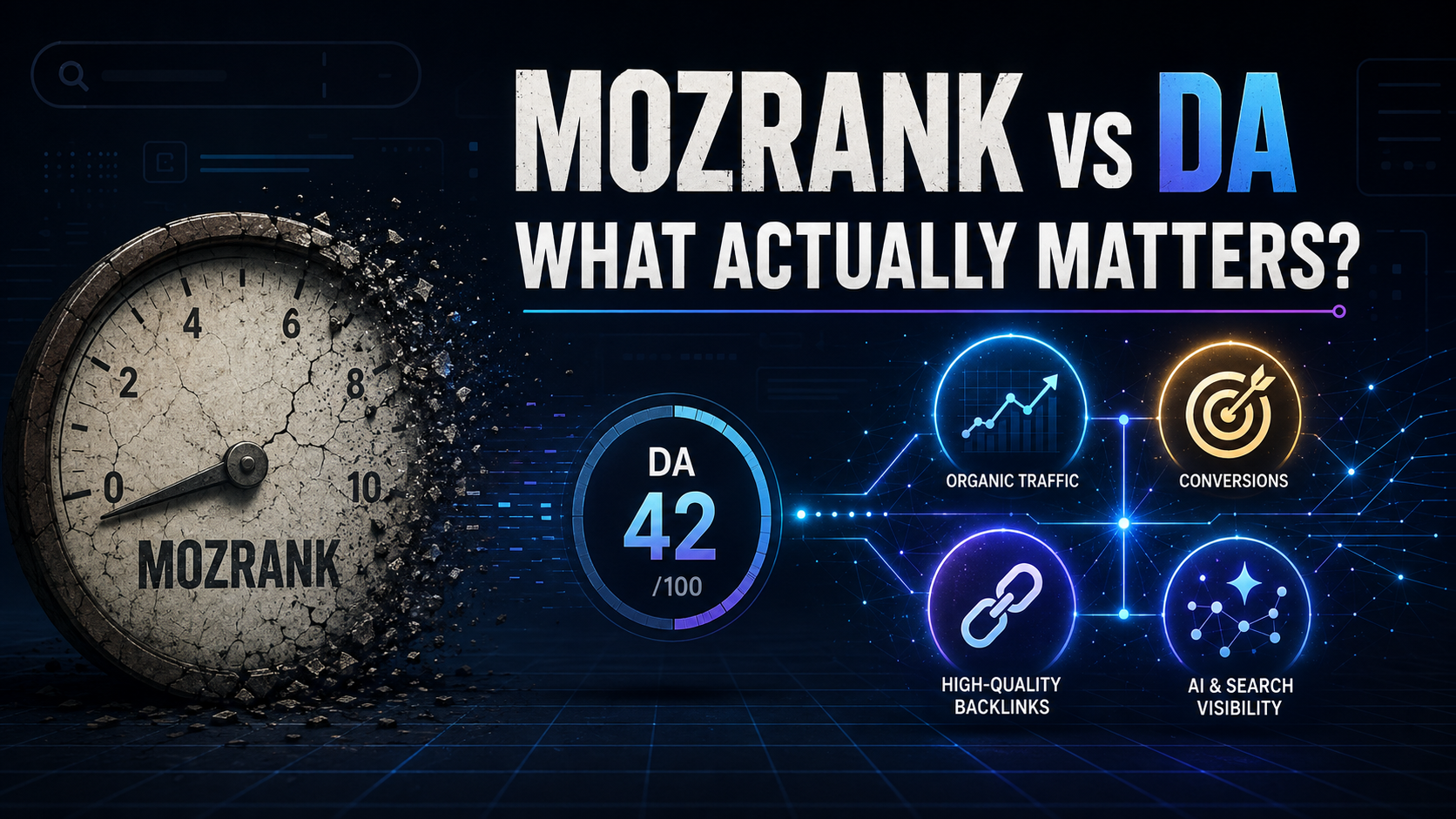
For years, SEO reports reduced website performance to one reassuring number. MozRank scored link popularity. Domain Authority estimated the ranking strength of an entire domain. A higher score looked like progress, and a lower score looked like a problem.
That was always an oversimplification. In 2026, it is also an outdated way to manage SEO.
MozRank is now a legacy metric rather than a practical industry benchmark. Domain Authority remains useful, but it is a proprietary comparison score created by Moz—not a Google ranking factor and not a business outcome. A website can gain Domain Authority while producing no additional leads or revenue. A young niche site can have a low DA and still outrank a much stronger domain for a specific query.
The short answer is this:
If you must choose between MozRank and Domain Authority, Domain Authority is the more useful comparative metric. But neither should be your primary SEO KPI.
The metrics that matter most are qualified organic traffic, conversions, query and page performance, relevant referring domains, technical eligibility, and—now—visibility in generative search features.
What Is MozRank?
MozRank was a Moz metric designed to estimate the link popularity of a web page. It used a logarithmic scale from 0 to 10 and considered both the number of incoming links and the strength of the pages providing those links.
The underlying idea was sensible: a link from a strong page should carry more weight than dozens of links from weak or irrelevant pages. MozRank was conceptually similar to the public-facing interpretation of Google PageRank, although the two metrics came from different companies, crawlers, data sets, and algorithms.
The problem is not that MozRank was meaningless. The problem is that it represented only a narrow slice of search performance: page-level link popularity. It did not measure search demand, content relevance, technical accessibility, user behavior, conversions, or revenue.
Modern SEO platforms have largely shifted toward broader or more clearly defined metrics such as Domain Authority, Page Authority, Domain Rating, URL Rating, Authority Score, organic traffic estimates, and spam indicators. As a result, monitoring MozRank in a 2026 SEO dashboard adds little practical value.
What Is Domain Authority?
Domain Authority, usually shortened to DA, is a Moz score intended to predict how likely a domain is to rank compared with other domains. It uses a logarithmic scale from 1 to 100, so moving from 20 to 30 is generally easier than moving from 70 to 80.
DA is useful because it compresses a complicated backlink profile into a number that is easy to compare. It can help with:
- benchmarking a website against genuine search competitors;
- reviewing the relative strength of several domains;
- screening potential outreach or digital PR targets;
- monitoring the broad direction of a link-building campaign;
- adding context to an acquisition or expired-domain review.
But the score has strict limits. DA is calculated from Moz’s data and model, not Google’s internal systems. It does not tell you whether a page satisfies a specific search intent, whether Google has indexed it, whether its traffic converts, or whether its backlinks are contextually relevant to your market.
Most importantly, increasing DA does not directly increase Google rankings. The actions behind the increase—earning credible links, publishing useful resources, improving topical coverage, and strengthening internal linking—may help search performance. The third-party score is only an imperfect reflection of some of that work.
Is Domain Authority a Google Ranking Factor?
No. Domain Authority is not a Google ranking factor.
Google does use link analysis. Its documentation says that PageRank remains part of its core ranking systems, while also making clear that Search uses many other signals. Google’s own SEO guidance warns against reducing ranking success to links or any single metric.
This distinction matters:
- Google PageRank is part of Google’s internal ranking systems.
- Moz Domain Authority is an external estimate based on Moz’s index and model.
- Ahrefs Domain Rating measures the relative strength of a domain’s backlink profile.
- Semrush Authority Score combines link power, estimated organic traffic, and spam-related signals.
These third-party metrics can correlate with search performance because they measure some characteristics that strong websites often have. Correlation does not mean that Google imports or uses the score.
MozRank vs Domain Authority: Which One Is More Useful?
Domain Authority is more useful for comparing domains. MozRank was narrower, page-focused, and is now mainly relevant when interpreting old SEO reports, APIs, or articles.
| Metric | Scope | What It Tries to Measure | Best Use | Main Limitation |
|---|---|---|---|---|
| MozRank | Page | Link popularity | Reading legacy reports | Outdated and too narrow for modern SEO management |
| Domain Authority (Moz) | Domain | Relative ranking potential | Comparing similar domains | Not a Google metric or business KPI |
| Page Authority (Moz) | Page | Relative ranking potential of a URL | Comparing competing pages | Still a third-party estimate |
| Domain Rating (Ahrefs) | Domain | Backlink profile strength | Link analysis and prospect comparison | Focused heavily on links |
| URL Rating (Ahrefs) | Page | Backlink strength of a URL | Evaluating ranking pages and link targets | Does not measure intent or conversions |
| Authority Score (Semrush) | Domain or page | Link power, estimated traffic, and manipulation signals | Broad quality screening | Depends on Semrush data and weighting |
The correct metric depends on the decision. If you are comparing entire competitor sites, DA, DR, or Authority Score can provide a quick first filter. If you are analyzing why one article outranks another, page-level metrics and the actual search result are more informative. If you are deciding whether SEO is creating business value, none of these authority scores is sufficient.
What SEO Metrics Matter More in 2026?
The best SEO scorecard moves from business outcomes to diagnostic metrics—not the other way around.
1. Organic Conversions and Revenue
Start with the actions that justify the work: qualified leads, purchases, subscriptions, demo requests, downloads, or another meaningful key event. Google recommends using Search Console as the source of truth for Google Search performance and Analytics for behavior after a visitor reaches the site.
Traffic without a relevant action may still build awareness, but it should not be confused with commercial progress.
2. Search Console Clicks, Impressions, CTR, and Queries
Search Console shows whether demand and visibility are changing at the query and page level.
- Impressions reveal where Google is showing the site.
- Clicks show actual visits from search results.
- CTR can expose weak titles, snippets, or mismatched intent.
- Query data shows which problems and topics Google associates with the site.
- Page data identifies winners, declining assets, and content that is close to producing more traffic.
Average position is useful as a directional metric, but it should not be read as a universal rank. Results vary by query, device, location, and search feature.
3. Branded vs Non-Branded Search Performance
Branded demand and non-branded discovery represent different kinds of growth.
More branded searches may indicate stronger awareness. More non-branded clicks usually mean the site is reaching people who did not already know the company. Mixing both into one traffic number can hide whether SEO is generating discovery or simply harvesting existing brand demand.
4. Generative AI Visibility
In June 2026, Google introduced dedicated Search Console reporting for impressions in generative AI features, including AI Overviews and AI Mode. The report is being rolled out gradually, but it gives site owners a direct way to monitor which pages appear in these experiences.
This does not make traditional SEO obsolete. Google’s guidance says that the same foundational SEO practices apply to AI features and that there are no separate technical requirements beyond being indexed and eligible to appear in Search with a snippet.
For a modern dashboard, track AI impressions alongside conventional search visibility. Do not replace clicks, conversions, or revenue with a vague “AI visibility score” from another vendor.
5. Relevant Referring Domains and Page-Level Links
A raw backlink total is easy to inflate. A better link review asks:
- Is the referring site topically relevant?
- Does it have real organic visibility or a credible audience?
- Is the link placed inside useful editorial context?
- Does it point to the page that needs support?
- Does the source link indiscriminately to hundreds of unrelated sites?
- Is the link likely to send referral traffic or build brand discovery?
Use DA, DR, or Authority Score as filters—not verdicts. Ahrefs itself advises against judging a site on a domain-wide authority score alone and recommends checking content quality, topical relevance, organic traffic, backlink quality, and outbound linking behavior.
6. Indexing and Technical Health
A page cannot perform if search engines cannot reliably crawl, render, index, and understand it. Monitor:
- indexation of commercially and editorially important pages;
- accidental
noindex, robots.txt, canonical, or redirect problems; - server errors and unstable response times;
- internal links to important pages;
- mobile rendering and usability;
- Core Web Vitals and severe page-experience issues;
- structured data where it genuinely supports a search feature.
Technical scores should still be prioritized by impact. Fixing a blocked revenue page matters more than moving an audit score from 94 to 100.
A Practical SEO Dashboard
| Layer | Metrics | Review Frequency | Decision It Supports |
| Business | Organic leads, purchases, revenue, conversion rate | Weekly or monthly | Is SEO creating value? |
| Search demand | Branded and non-branded impressions and clicks | Monthly | Are awareness and discovery growing? |
| Page performance | Landing-page clicks, CTR, conversions, query groups | Weekly or monthly | Which pages should be updated or expanded? |
| AI visibility | AI Overview and AI Mode impressions, visible pages | Monthly | Which content is being surfaced in generative search? |
| Authority | Relevant referring domains, links to priority pages, DA/DR/AS trend | Monthly | Is the site’s external credibility improving? |
| Technical | Indexation, crawl errors, canonical issues, Core Web Vitals | Weekly or after releases | Is anything preventing performance? |
This hierarchy prevents a common reporting failure: celebrating a five-point DA increase while organic leads are falling.
What Is a Good Domain Authority Score?
There is no universal “good” DA.
A DA of 25 may be strong in a small industrial niche and weak in consumer finance. A new software tool does not need to match Wikipedia, Amazon, or a global media company. It needs enough credibility and page-level relevance to compete for the queries that support its business.
Use DA comparatively:
- Identify the domains that consistently rank for your target topics.
- Exclude giant platforms that are not realistic business competitors.
- Compare DA together with organic traffic, ranking pages, referring-domain quality, and topical overlap.
- Track the direction over time rather than obsessing over short-term fluctuations.
- Investigate score changes before treating them as wins or losses; third-party indexes and relative scales also change.
How Do You Build Real Search Authority?
Do not optimize for the score. Build assets that make the score more likely to rise as a side effect.
Publish Evidence, Not Generic Summaries
Original data, experiments, benchmarks, calculators, templates, decision logs, technical breakdowns, and honest case studies give other sites a reason to cite you. A generic AI-generated summary rarely earns durable links because it adds nothing that another site cannot reproduce in minutes.
Build Topic Clusters Around Real Expertise
Cover a subject deeply enough that individual articles support one another. Connect strategic explanations to practical guides, examples, tools, and postmortems. Internal links help users and crawlers discover related pages while distributing attention toward important assets.
Earn Links Through Distribution
Good content does not distribute itself. Share useful findings with niche publications, communities, newsletters, partners, customers, and people already writing about the problem. Digital PR works best when the pitch contains evidence or a genuinely useful resource—not a request to “exchange backlinks.”
Strengthen Pages That Already Show Demand
Pages with growing impressions but weak CTR or positions just outside the top results often offer better returns than publishing another unrelated article. Improve the answer, add first-hand evidence, update screenshots and facts, clarify the structure, and earn links directly to that page.
Measure the Commercial Result
The final question is not “Did DA increase?” It is “Did more of the right people discover the site and take a valuable action?”
Frequently Asked Questions
Is MozRank Still Important in 2026?
Not as an operational KPI. MozRank can help explain historical reports, but current SEO work is better served by page- and domain-level authority metrics, Search Console data, technical diagnostics, and business outcomes.
Is Domain Authority More Important Than MozRank?
Domain Authority is more useful for comparing the overall strength of similar domains. That does not make it a Google ranking factor or a replacement for traffic, conversions, content quality, or page-level analysis.
Can a Low-DA Website Rank Above a High-DA Website?
Yes. A lower-authority site can win when its page better satisfies the query, provides stronger evidence, targets a narrower topic, has relevant page-level links, or offers a better result for that search intent.
Should You Buy Backlinks Based on DA or DR?
No. A high score alone does not prove that a site is relevant, trusted, visible, or safe. Review its real content, ranking history, traffic, topical fit, outbound links, ownership patterns, and the context in which your link would appear. Paid links intended to manipulate rankings can violate Google’s spam policies.
Why Did Domain Authority Fall When No Links Were Lost?
Authority scores are relative and depend on a third-party index. Competitors may gain stronger links, the provider may recrawl or reclassify pages, or the scoring model may change. Check real search performance before treating a DA change as an SEO incident.
Does AI Search Make Domain Authority More Important?
AI search increases the value of being a credible, clearly structured, citable source, but no public evidence shows that Google AI Overviews or AI Mode use Moz DA as an input. Google says its standard SEO foundations still apply to generative search features.
Final Verdict
The old MozRank-versus-Domain-Authority debate asks the wrong question.
MozRank is a legacy link-popularity metric. Domain Authority is a more useful comparative score, but it remains an external estimate. Neither is the goal, and neither can tell you whether SEO is producing revenue, qualified demand, or durable visibility.
Use authority metrics to add context. Use Search Console to understand visibility. Use Analytics and CRM data to measure outcomes. Use page-level evidence to decide what to improve. And in 2026, add generative AI impressions to the dashboard without turning them into another vanity score.
The metric should support the decision. It should never become the strategy.