

An llms.txt file can help an AI agent navigate your website. It cannot establish that your company deserves to be recommended.
That distinction matters when teams turn AI visibility into a content project. A small Markdown file is easy to ship. Specialist pages, documented results and credible ecosystem relationships take sustained work. The visible deliverable can end up replacing the harder strategy.
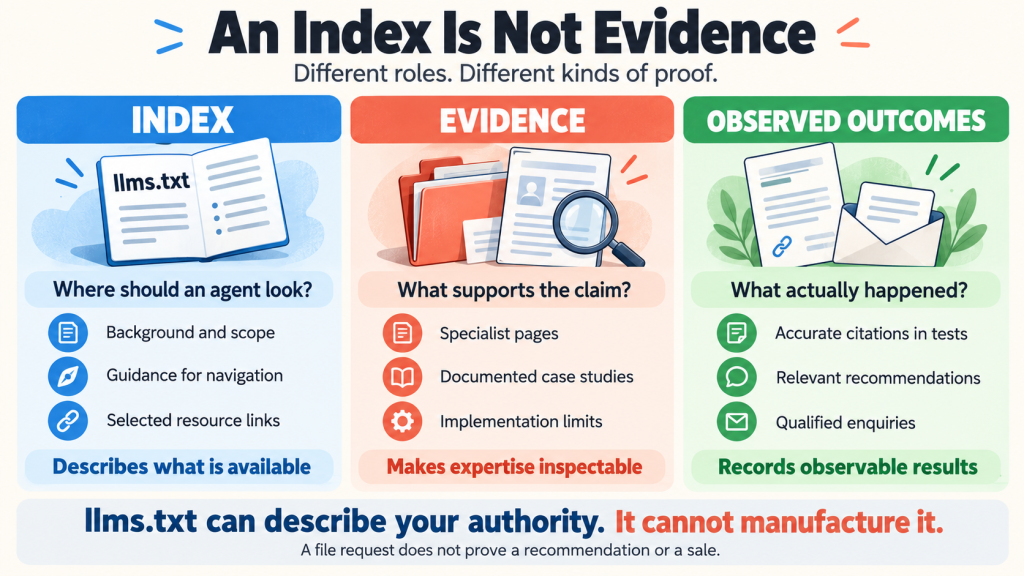
llms.txt can describe your authority. It cannot manufacture it.
An AI distribution strategy should explain which buyer questions you want to appear in, what evidence supports your inclusion, where that evidence is available, and how you will assess the commercial result. The file has a supporting role within that work.
What llms.txt actually does
The llms.txt proposal describes a Markdown overview that gives agents background, guidance and links to more detailed resources. Its August 2026 revision also discusses clean Markdown page versions and ways to help clients discover them.
Think of it as an editorial index: an explanation of what a site contains and where to look next.
For a software product, that might mean pointing an agent toward setup instructions, API references, limitations and examples. For a service business, it might mean introducing its specialisms and linking to relevant service pages and case studies.
Its usefulness depends on a system discovering and using it. Publishing the file does not establish that every answer engine reads it, relies on it or uses it to select recommendations.
A directory of expertise and evidence of expertise serve different purposes.
AI discovery is not one universal channel
“Make us visible to AI” is too vague to guide investment.
A coding agent navigating documentation, an assistant retrieving information from a supplied URL, and a search product selecting sources for a buyer’s question are different situations. Evidence that a format helps one workflow does not establish a ranking benefit in another.
Google’s guidance for AI Overviews and AI Mode says existing SEO fundamentals apply and additional AI text files are unnecessary. Supporting pages must be indexed and eligible to appear with a search snippet; inclusion is not guaranteed.
OpenAI’s crawler documentation separately identifies OAI-SearchBot for search discovery and GPTBot for potential model-training content. Their controls are independent.
The management implication is straightforward: define the discovery surface before choosing the deliverable. “We published llms.txt” describes an implementation task. “Relevant buyers can find accurate evidence about this service” describes an outcome worth investigating.
Build something worth retrieving
The following priorities are an editorial and operating framework, not a disclosed ranking formula.
1. Publish specialist pages that answer buyer questions
A homepage promising “digital transformation” gives a reader little basis for choosing a supplier.
Consider a hypothetical integration agency. A useful specialist page might explain how it synchronizes stock between an online store and a CRM: supported systems, synchronization direction, update frequency, failure handling and implementation boundaries.
That is more informative than a page repeating “automation experts” in several variations.
Build pages around actual buying decisions. Explain what you solve, for whom, under which conditions, and where the solution stops. Keep important explanations available as readable text and connect related pages through useful internal links.
2. Make the evidence inspectable
A case study should let someone assess the work rather than simply admire the claim.
Describe the starting problem, constraints, implementation, outcome and remaining limitations. Identify the client when permission allows. If a case is anonymized, say so and retain enough detail to explain what happened.
Use measured results only when you can support them. Without reliable before-and-after numbers, publish the architecture, workflow change, failure conditions or acceptance criteria instead.
“Reduced manual work” is an assertion. An explanation of which manual steps disappeared, which exceptions remain and how the result was checked provides evidence.
3. Earn accurate mentions where your market already looks
Relevant partner directories, integration marketplaces, customer stories, specialist publications and useful community contributions can give people additional places to discover and evaluate a business.
Prioritize relevance and accuracy over mention counts. A listing that correctly describes your integration scope can be more useful to a buyer than a collection of generic directory entries.
Treat these placements as distribution and corroboration opportunities. The sources above do not establish a universal formula connecting external mentions to AI recommendations.
4. Keep the company’s description consistent
Choose stable names for the company, products and core services. Explain aliases or rebrands. Align factual descriptions across the website, documentation and partner profiles.
Consistency should clarify identity, not flatten every page into identical marketing copy.
If one page describes a managed service while another implies a self-service product, the problem is substantive. An llms.txt summary should not have to reconcile a business model the company has not explained clearly.
Give llms.txt a bounded job
Use the file when it can provide a useful route into material you already maintain.
Select important resources, describe them briefly and link to the authoritative detail. Keep scope and limitations aligned with the underlying pages. Assign an owner so the index does not outlive the accuracy of its contents.
For documentation-heavy products, this may deserve early attention because helping agents navigate technical material is directly relevant to product use.
For a service business with thin pages and unsupported claims, the higher-value task may be publishing one credible case study.
The practical rule is to time-box the index and fund the evidence. If maintaining the summary becomes a larger project than improving the material it summarizes, revisit the allocation.
Measure discovery, accuracy and business value separately
Use a small, repeatable set of real buyer questions to observe whether systems mention the company, cite relevant pages and describe the offer correctly.
Record the product, date, language, exact prompt and whether web search was enabled. Keep branded questions separate from unbranded buying questions: asking about your company tests something different from asking for a suitable supplier.
Treat these observations as samples, not a universal visibility score.
Then distinguish three kinds of evidence:
- Access: verified crawler requests and successful page retrieval.
- Representation: relevant citations, accurate descriptions and appropriate recommendations in recorded tests.
- Business value: attributable visits, qualified enquiries and customer-reported discovery paths.
A request for llms.txt proves that a request occurred. It does not prove a recommendation or a sale. Likewise, an improvement after several simultaneous content changes cannot automatically be credited to that file.
The decision for the next content sprint
Choose a buyer question that matters commercially. Inspect the pages that should answer it. Strengthen the evidence, remove access barriers and improve relevant distribution. Add or update llms.txt where it helps agents navigate that work.
The file can be a useful part of the system. Authority still has to come from something the business can demonstrate.