
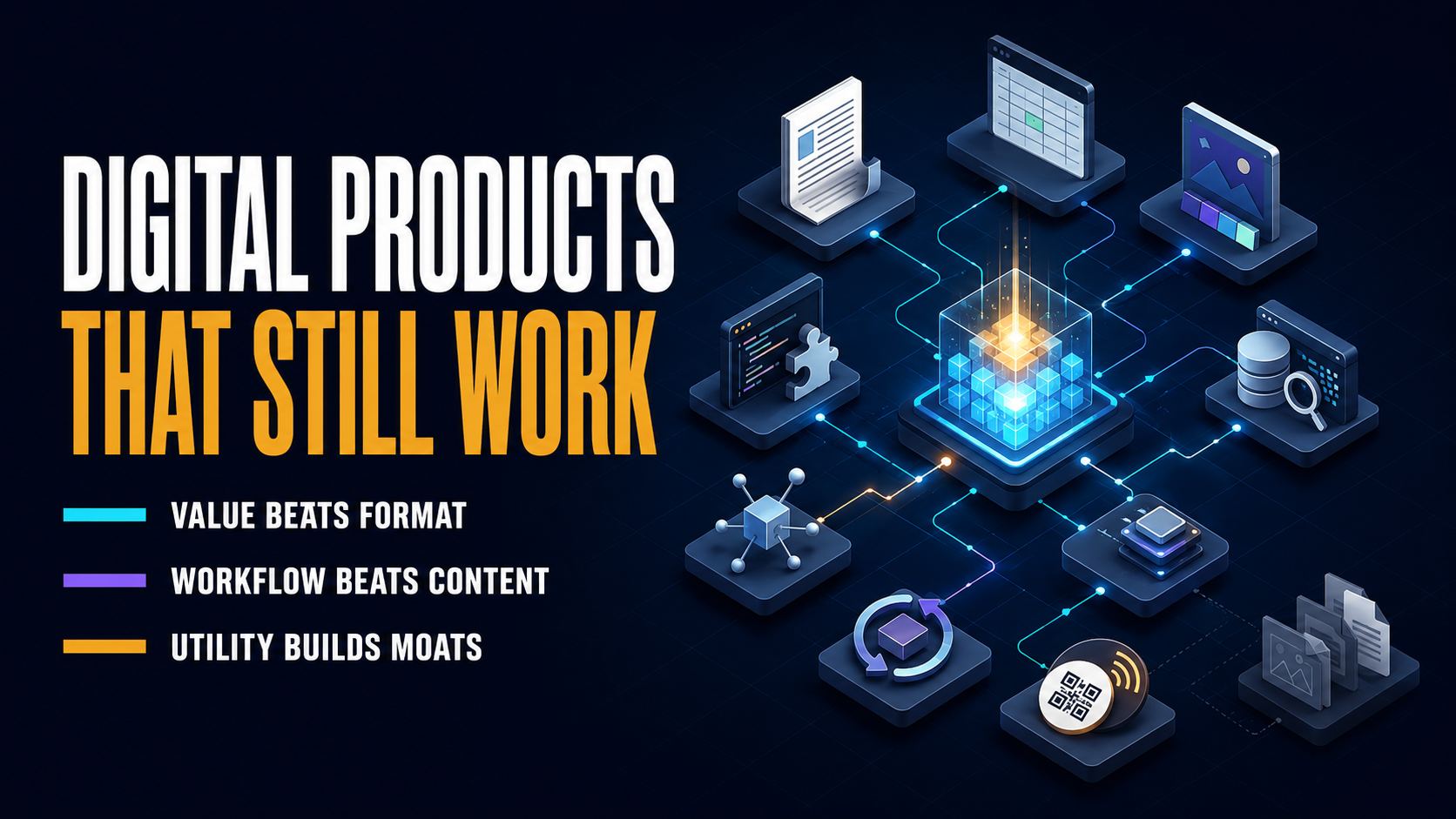
Digital products are no longer a narrow category of ebooks, music files, and downloadable software. They include calculators, datasets, plugins, APIs, browser tools, automation workflows, paid research, continuously updated libraries, and physical products with a digital operating layer.
At the same time, producing a digital file has become radically easier. AI can generate a generic guide, prompt pack, stock illustration, landing-page template, or code snippet in minutes. That does not eliminate the digital product opportunity. It changes where the value lives.
The strongest products in 2026 do at least one of five things:
- complete a job rather than merely explain it;
- save meaningful time inside a specific workflow;
- provide trusted data, calculation, or functionality;
- stay current as the underlying environment changes;
- grant useful access or usage rights that a free alternative cannot.
This guide covers 30 types of digital products from both sides of the transaction: what consumers should evaluate and what creators need to build, maintain, and monetize.
What Is a Digital Product?
A digital product is a repeatable unit of value delivered through software, data, media, files, online access, or digitally enabled functionality.
The word “product” matters. A custom website built separately for every client is a service. A reusable website theme sold to many customers is a product. A monthly analytics review performed manually is a service. A self-serve dashboard with a standard data connector is a product. A hybrid can combine both.
A useful digital-product definition has four layers:
- Value: the result the buyer receives.
- Format: file, software, data, access, license, or connected experience.
- Delivery: download, account access, API, app store, email, or device integration.
- Rights: personal use, commercial use, team access, modification, resale, or another license.
The same PDF file could be a free lead magnet, a $29 checklist, a $300 licensed operating manual, or part of a paid update service. The file format does not determine the business model.
Six Major Digital Product Families
| Family | Main value | Typical delivery | Common pricing |
|---|---|---|---|
| Knowledge and workflow products | Clarity, decisions, faster execution | PDF, document, workspace, spreadsheet | One-time, bundle, paid updates |
| Creative and production assets | Faster or better creative output | Download, asset library, license | One-time, commercial license, subscription |
| Code and software products | Automation and functional outcomes | Download, app, plugin, hosted access | License, one-time, subscription, usage-based |
| Data and AI products | Better inputs, analysis, or automated decisions | Dataset, API, dashboard, workflow | One-time, subscription, usage-based |
| Access and recurring products | Freshness, convenience, continuous utility | Account, feed, library, hosted service | Subscription, annual access, credits |
| Hybrid physical-digital products | Connected functionality and traceability | Device, QR/NFC, app, web portal | Hardware plus software, subscription, service plan |
The families overlap. A market database can be a downloadable spreadsheet, a searchable web application, or an API subscription. The right delivery model depends on update frequency, customer workflow, support burden, and the defensibility required.
Knowledge and Workflow Products
These products package information, decisions, or repeatable processes. They are easy to start and therefore highly competitive. Their value rises when they are specific, tested, current, and immediately usable.
1. Ebooks and Short Guides
Ebooks work best when they provide concentrated expertise, original research, a strong point of view, or a complete answer for a narrow audience. Broad introductory ebooks are increasingly replaceable by free search results and AI-generated summaries.
Strong example: a concise guide to migrating a specific ERP integration without losing order identifiers.
Weak example: “100 Ways to Be More Productive.”
For consumers, check the publication date, author evidence, table of contents, sample pages, and update policy. For creators, sell reduced uncertainty—not page count.
2. Operational Playbooks and SOPs
Playbooks, standard operating procedures, checklists, and decision trees convert experience into execution. They can be more valuable than an ebook because the buyer uses them during a real task.
Examples include:
- incident-response runbooks;
- marketplace launch checklists;
- client onboarding systems;
- content production workflows;
- data-migration procedures;
- compliance evidence checklists.
The strongest playbooks include triggers, owners, inputs, outputs, exceptions, templates, and examples. A list of generic tips is not an operating system.
3. Paid Research Reports and Case Studies
Paid research turns expensive collection, synthesis, or firsthand experience into a product. Buyers pay to avoid repeating the work or to see evidence unavailable in generic content.
Useful formats include:
- market maps;
- competitor teardowns;
- benchmark reports;
- implementation postmortems;
- financial or operational case studies;
- regulatory opportunity reports;
- datasets accompanied by analysis.
This format fits specialist builders particularly well: one real 0→revenue experiment can generate a paid case study, supporting spreadsheet, public article, and later software idea.
4. Printable Products
Printables are downloadable files intended for physical printing: planners, worksheets, labels, invitations, educational materials, wall art, and activity packs.
They have low delivery cost but severe competition and low switching barriers. Commercial viability depends on a specific use, distinctive design, correct print formats, clear dimensions, and excellent previews. Generic planner bundles are heavily commoditized.
5. Document Templates
Document templates help buyers create consistent outputs without starting from a blank page. Examples include proposals, briefs, audits, contracts, reports, editorial calendars, and product requirement documents.
A template becomes stronger when it includes:
- guidance inside each field;
- completed examples;
- conditional sections;
- version history;
- compatible formats;
- team or commercial usage rights.
Legal, financial, and compliance templates require careful jurisdictional disclaimers and professional review. A template is not automatically legal advice.
6. Presentation and Pitch-Deck Systems
Presentation products include slide templates, chart libraries, investor-deck structures, sales proposals, webinar decks, and reporting systems.
The buyer is rarely paying for decorative slides alone. They are paying for narrative structure, editable components, brand consistency, and faster delivery. Industry-specific deck systems are more defensible than generic “modern business” templates.
7. Spreadsheets, Calculators, and Financial Models
Spreadsheets can convert logic into an immediately useful tool without requiring custom software. Examples include pricing calculators, inventory forecasts, unit-economics models, content scoring systems, tax estimators, and scenario planners.
Their advantages are transparency, portability, and low development cost. Their risks are formula errors, broken references, version differences, and user input mistakes.
Creators should include validation, protected formula cells, sample data, assumptions, error messages, and documentation. Buyers should inspect what the model assumes before trusting its output.
8. Workspace and Database Templates
These products package linked databases, views, automations, dashboards, and workflows for tools such as project-management or knowledge platforms.
A workspace is more valuable than a page template when it models a complete process: CRM-lite, content production, product research, hiring, or incident management. The downside is dependency on the host platform’s features, pricing, and API.
The creator must state required plan levels, integrations, setup time, mobile limitations, and what breaks if the platform changes.
Creative and Production Assets
Creative assets are purchased to accelerate another product, campaign, game, video, website, or brand. Here, licensing and consistency can matter as much as the files.
9. UI Kits and Design Systems
UI kits provide reusable interface components, patterns, tokens, and screens. A design system may also include rules, accessibility guidance, variables, and code mappings.
The strongest products are internally consistent and production-aware. Fifty unrelated screens are less useful than a smaller component system with clear states, responsive behavior, and implementation notes.
10. Icons, Illustrations, Fonts, and Graphic Packs
These products provide a visual language for websites, apps, presentations, packaging, or campaigns. Buyers evaluate style consistency, format coverage, editability, licensing, and whether new assets will be added.
AI has increased the supply of individual illustrations. Cohesive systems remain harder to replace because buyers need repeatable style, predictable geometry, and commercial rights across many outputs.
11. Photos, Video, Motion Graphics, and 3D Assets
Stock photos, footage, transitions, LUTs, 3D models, textures, and animation rigs save production time. Value depends on quality, technical compatibility, releases, metadata, and licensing.
Consumers should verify whether commercial use, client work, advertising, broadcast, modification, and resale inside a larger product are permitted. “Royalty-free” does not mean “free of restrictions.”
12. Audio, Music, Sound Effects, and Voice Assets
Audio products include music tracks, loops, stems, sound effects, sample packs, podcast intros, and synthetic voice assets.
Licensing must address platforms, advertising, synchronization, redistribution, content identification systems, and whether the buyer can modify the asset. AI-generated voices also raise consent, identity, and platform-policy risks that a generic license may not resolve.
13. Website Themes and Page Templates
Themes and templates accelerate websites, ecommerce stores, landing pages, and email campaigns. Buyers pay for layout, responsive behavior, reusable sections, performance, and platform compatibility.
The operational burden is significant. Platform updates, browser changes, accessibility, app conflicts, and support requests can turn a one-time product into a long-term maintenance obligation.
Creators should define supported versions and an update window. Consumers should check recent changelogs and support activity rather than relying on total historical sales.
Code and Software Products
Software products usually offer stronger functional value and more defensibility than static content. They also introduce security, compatibility, reliability, and maintenance obligations.
14. Code Components and Starter Kits
Code components package reusable application functions: authentication, payments, dashboards, forms, data import, notifications, or common infrastructure.
Starter kits save setup time, but buyers inherit architectural choices and dependencies. A good kit has tests, documentation, clean upgrade paths, security notes, examples, and a transparent dependency policy.
Code volume is not the value. Reduced implementation risk is.
15. Scripts and Automation Packages
Scripts automate focused tasks such as file conversion, data cleanup, report generation, API synchronization, monitoring, or scheduled exports.
They are an excellent small-product format because the value can be measured in hours saved. The challenge is environmental diversity: operating systems, credentials, API versions, rate limits, and data formats.
Creators can reduce support by shipping configuration validation, dry-run mode, structured logs, sample inputs, and clear failure messages.
16. Plugins, Extensions, and Add-ons
Plugins add functionality to an existing ecosystem: ecommerce, CMS, browser, design tool, CRM, spreadsheet, or developer platform.
The platform supplies distribution and an installed base, but it also controls approval, permissions, visibility, APIs, and fees. A profitable plugin is partly a software business and partly a dependency-management business.
Before buying, consumers should inspect requested permissions, update cadence, compatibility, data handling, and export options. Before building, creators should model the impact of one API or policy change.
17. Desktop and Mobile Applications
Installed applications can work offline, integrate deeply with the device, process local files, or use native capabilities. They can be sold through app stores or directly with license keys.
App stores offer discovery and trusted payments but add review rules and platform dependence. Direct distribution gives more control but shifts installation, update, signing, payment, and support work to the creator.
18. Games and Interactive Experiences
Games, simulations, interactive fiction, virtual environments, and educational experiences are digital products whose value comes from participation rather than passive consumption.
Their economics differ from utility software. Content volume, retention, community, platform discovery, and production quality matter. A small game can still become a durable asset when scope is constrained and the core mechanic is distinct.
19. Micro-Tools and Hosted Utilities
A micro-tool completes one narrow job through a simple web interface: validate data, generate a document, check a domain, compare files, transform images, calculate a metric, or monitor a status.
This is one of the strongest formats for independent builders because it can start small, rank for a specific search intent, and expand only when usage proves demand.
Monetization options include:
- free tool plus paid exports;
- credits;
- one-time lifetime access;
- subscription for saved history or automation;
- affiliate or service leads;
- paid API access.
The Basein domain and hosting checker is an example of a tool-shaped content asset: it can answer a direct query while supporting related articles.
20. SaaS Products
Software as a Service provides hosted functionality through an account, normally with recurring or usage-based billing. The provider operates the application, infrastructure, updates, and data layer.
SaaS can create recurring revenue and stronger protection than a downloadable file. It also creates recurring obligations: uptime, security, backups, support, billing, data export, privacy, and continued product value.
A static feature should not become SaaS merely because subscriptions are attractive. Recurring billing needs recurring utility.
21. APIs and Developer Products
An API product provides data or functionality that another system can call programmatically. Examples include validation, messaging, document conversion, geocoding, identity, financial data, or AI inference.
The buyer evaluates documentation, latency, availability, rate limits, versioning, data rights, security, and migration cost. Usage-based pricing fits many APIs, but unpredictable bills can discourage adoption.
Good developer products include a sandbox, copyable examples, clear errors, status reporting, version policy, and export or fallback options.
Data and AI Products
AI makes raw generation cheap. It makes reliable inputs, evaluation, orchestration, and domain-specific data more valuable.
22. Datasets
Datasets package collected, cleaned, labeled, normalized, or enriched information. They may be delivered once or refreshed periodically.
Examples include:
- product catalogs;
- geospatial observations;
- business directories;
- pricing histories;
- annotated training data;
- market transactions;
- regulatory classifications.
Consumers need provenance, collection date, coverage, schema, allowed uses, update policy, and known gaps. Creators need the legal right to collect, transform, and license the data.
23. Curated Directories and Searchable Databases
A directory is not valuable because it contains many links. It is valuable because it reduces discovery and verification work for a defined buyer.
A useful directory may include normalized categories, filters, contact status, pricing, geography, last verification date, evidence, and a clear inclusion method. A static list of scraped names is easy to reproduce and rapidly becomes stale.
Recurring pricing makes sense when verification, coverage, or decision support continues.
24. Dashboards and Data Products
A data product combines sources, transformations, metrics, and presentation into a repeatable decision tool. It may be a downloadable report, a spreadsheet, a BI dashboard, or a hosted application.
Strong data products explain definitions and uncertainty. If “active customer,” “profit,” or “conversion” is calculated differently from the buyer’s expectation, a beautiful chart can still be wrong.
25. Prompt, Workflow, and Automation Packs
A prompt pack is a collection of instructions for an AI system. Generic packs have weak defensibility because prompts are easy to generate, copy, and adapt.
A stronger product packages an operational workflow:
- required inputs;
- prompt or agent stages;
- validation criteria;
- failure handling;
- examples;
- model alternatives;
- integrations;
- output templates;
- version updates.
The product is not the prompt. It is the tested system around the prompt.
26. AI Assistants, Agents, and Vertical AI Utilities
AI products can summarize documents, classify requests, extract fields, draft responses, monitor changes, or coordinate actions across tools.
The durable opportunity is usually vertical: a specific buyer, data structure, workflow, and acceptance criterion. A generic chat wrapper has low defensibility unless it owns distribution, data, integrations, or a superior workflow.
Creators must disclose important limitations, protect customer data, control permissions, log actions, and provide human review for high-impact tasks. Consumers should ask what model is used, where data goes, whether outputs are stored, and how errors are detected.
Purely AI-generated assets also create rights questions. The U.S. Copyright Office’s AI initiative states that its 2025 report addresses copyrightability of generative-AI outputs. Rules differ by jurisdiction and fact pattern, so creators should not promise exclusive rights they may not control.
Access, Licensing, and Recurring Products
Some digital products are defined less by format than by the right or continuity being sold.
27. Software Licenses, Activation Keys, and Usage Rights
A license grants permission to use software, media, data, or another asset under stated conditions. The buyer may receive a file but not ownership of the underlying intellectual property.
Common scopes include:
- personal use;
- one commercial project;
- unlimited client projects;
- one user, seat, site, or device;
- team or enterprise use;
- modification rights;
- redistribution rights;
- private-label or resale rights.
Creators should use plain-language license summaries backed by actual terms. Consumers should verify whether the planned use—especially client work, resale, AI training, or incorporation into another product—is allowed.
Creative Commons provides six standardized license types with different combinations of attribution, commercial use, derivatives, and share-alike conditions. A CC license is not interchangeable with a private commercial license.
28. Subscription Libraries and Continuously Updated Access
A subscription library provides ongoing access to assets, research, templates, data, or tools. The recurring value may come from:
- new items;
- updates to existing items;
- curation and verification;
- hosted functionality;
- saved work and collaboration;
- monitoring or alerts.
Subscriptions fail when a static archive is placed behind recurring billing without a credible update engine. They also create a production treadmill if every renewal depends on constant new volume.
Annual access with a defined update schedule can be a better fit than monthly billing for slow-changing professional products.
29. Paid Updates, Maintenance, and Support Plans
A one-time product can generate recurring revenue without forcing the entire product into a subscription. Customers can buy the current version and optionally pay for:
- another year of updates;
- new major versions;
- compatibility maintenance;
- priority support;
- monitoring;
- cloud synchronization;
- additional usage or team seats.
This separates ownership of the current deliverable from the cost of continued maintenance. The policy must explain what happens when the plan expires.
Hybrid Products
30. Productized Services and Physical-Digital Systems
Two important hybrid models sit at the boundary of digital products.
Productized service: a standardized result delivered with some human work. Examples include a fixed-scope audit, migration package, data cleanup, or installation service supported by reusable tools and templates. It offers higher trust and order value but does not scale like pure software.
Physical-digital product: a device or physical object connected to software, data, identity, or ongoing access. Examples include sensors, smart equipment, QR-linked product passports, NFC verification, and hardware with a management portal.
The digital layer can add traceability, configuration, analytics, updates, or recurring revenue. It also creates security, compatibility, data-retention, and end-of-service responsibilities. A physical product that depends on an abandoned cloud service may lose core functionality.
For a creator, hybrid products can be more defensible because they combine operational knowledge, integration, and physical context. They are also more expensive to support.
The Delivery Model Is Not the Product Type
The 2023 version of this article treated downloads and subscriptions as separate product categories. That is incomplete. They are delivery and payment models that can apply to many product types.
| Model | What the buyer receives | Good fit | Main risk |
| One-time download | Current files or software version | Templates, assets, reports, utilities | Piracy, weak repeat revenue |
| One-time license | Defined usage rights | Software, fonts, media, commercial assets | License confusion and enforcement |
| Subscription | Ongoing access or recurring value | SaaS, current data, libraries, monitoring | Churn and continuous obligation |
| Usage-based | Measured calls, credits, storage, or output | APIs, AI processing, conversion tools | Unpredictable bills |
| Paid updates | Current product plus optional future maintenance | Plugins, themes, datasets, professional tools | Fragmented versions |
| Freemium | Limited free product plus paid capability | Tools with cheap free usage and clear upgrade trigger | Free users create cost without conversion |
| Bundle | Several related products sold together | Cohesive workflow or asset family | Artificial value through irrelevant bonuses |
| Hybrid service | Standard product plus implementation | Complex B2B outcomes | Calendar and labor dependence |
Choose delivery after defining the recurring nature of the value.
Which Product Types Are Most Defensible in 2026?
| Product type | AI substitution risk | Ongoing work | Defensibility potential | Best moat |
| Generic ebook | High | Low | Low | Original evidence and audience |
| Narrow playbook | Medium | Medium | Medium | Tested workflow and updates |
| Template bundle | High | Low–medium | Low–medium | Workflow fit and coherent system |
| Spreadsheet/calculator | Medium | Medium | Medium–high | Correct logic and decision value |
| Paid case study | Medium | Low–medium | Medium | Firsthand data and artifacts |
| Creative asset pack | High | Medium | Medium | Distinct system and licensing |
| Plugin or extension | Medium | High | High | Ecosystem integration and maintenance |
| Micro-tool | Medium | Medium | High | Convenience, distribution, saved data |
| SaaS | Medium | High | High | Workflow integration and switching cost |
| API | Low–medium | High | High | Reliability, data, documentation |
| Dataset | Medium | High | High | Provenance, coverage, refresh cycle |
| Curated database | Medium | High | High | Verification and decision layer |
| Generic prompt pack | Very high | Low | Very low | Usually none |
| Vertical AI utility | Medium | High | High | Data, integration, evaluation workflow |
| Physical-digital system | Low | Very high | High | Hardware, operations, installed base |
This is not a universal ranking. A generic product with excellent distribution can outperform a technically defensible one nobody discovers. Commercial strength is a combination of product value, moat, and acquisition.
Digital Products That Are Harder to Sell Now
Generic Information Products
If free articles and a single AI query can reproduce most of the result, the buyer needs another reason to pay: trust, evidence, structure, convenience, implementation, or updates.
Random Template Mega-Bundles
“10,000 templates” often signals low curation. Buyers need a coherent outcome, not a folder to sort.
Generic Prompt Packs
Prompts detached from a workflow, evaluation method, and examples are easy to regenerate and rapidly become outdated as models change.
Unverified Directories
Scraped lists decay quickly. Without freshness dates, criteria, and verification, the product transfers research risk to the buyer rather than removing it.
PLR and Resale-Rights Bundles Without Differentiation
Private Label Rights, Master Resell Rights, Resell Rights, and Personal Use licenses grant different permissions. They do not create demand. If many buyers can resell the same material, competition moves toward price and aggressive promotion.
Read How to Resell Digital Products: PLR, MRR, RR, and PU before assuming “resale rights” means unrestricted use.
Abandoned Plugins and Themes
Software tied to another platform loses value quickly when updates stop. Historical reviews do not guarantee current compatibility or security.
How Consumers Should Evaluate a Digital Product
1. Define the Outcome
What will be faster, cheaper, safer, or possible after the purchase? “Useful resources” is not an outcome.
2. Verify Compatibility
Check operating systems, app versions, file formats, required accounts, plan levels, fonts, plugins, integrations, and technical skill.
3. Inspect Freshness
Look for a publication date, product version, changelog, verification date, and update policy. Freshness is essential for legal, platform, market, software, and data products.
4. Read the License
Confirm whether the product permits commercial use, modification, client work, team access, redistribution, or incorporation into another product.
5. Understand Access and Exit
Can files be exported? What happens after cancellation? Does the product require a live platform, account, or API? Can access disappear if the provider closes?
6. Review Privacy and Permissions
For apps, plugins, AI tools, and connected products, inspect what data is collected, which permissions are requested, where data is processed, and how deletion works.
7. Check the Refund and Support Policy
Digital content has specific consumer rules. In the EU, the usual withdrawal right can be lost once downloading or streaming begins only after the consumer gives the required agreement and acknowledgment. The official EU guidance on returns and withdrawal explains the exception.
Also check whether “support” covers installation, bug fixes, customization, or only access problems.
How Creators Should Choose a Digital Product Type
Step 1: Start With Repeated Work
Look for a task you or a customer performs repeatedly. Products emerge from repeated decisions, transformations, calculations, and setup—not from brainstorming file formats.
Step 2: Identify the Value Engine
Is the buyer paying for:
- knowledge;
- speed;
- accurate calculation;
- creative output;
- automation;
- trusted data;
- continuous access;
- reduced risk;
- permission to use an asset?
This determines the format and pricing better than “Should I make an ebook or a course?”
Step 3: Choose the Smallest Complete Delivery
Use the least complex format that delivers the result:
- checklist before application;
- spreadsheet before custom SaaS;
- script before orchestration platform;
- manually verified report before live database;
- hosted micro-tool before full product suite.
Do not build recurring infrastructure before proving recurring use.
Step 4: Validate Willingness to Pay
Use a landing page, paid pilot, preorder, direct offer, marketplace listing, or manual delivery. Compliments are not validation.
The same principles from How to Validate Your Service Idea apply: find the buyer, test the pain, and seek commitment before overbuilding.
Step 5: Model the Full Operating Cost
Include production, revisions, hosting, API usage, support, refunds, payment fees, platform commissions, tax operations, security, and updates.
Digital products require tax classification. Stripe, for example, separates tax codes for SaaS, downloadable software, ebooks, audio, images, and other digital goods. Classification and obligations depend on the product and jurisdiction.
Step 6: Design the License and Update Promise
Decide what the buyer owns, what they may do, how many users or projects are included, and what future versions cost. Do this before the first dispute.
Step 7: Build Distribution Into the Product
A product needs a discovery path:
- search intent;
- marketplace demand;
- a free utility;
- integration ecosystem;
- affiliates;
- professional audience;
- direct B2B outreach;
- existing clients with the same repeated problem.
The most elegant product type cannot compensate for zero distribution.
For the wider economics, read Selling Digital Products in 2026: Advantages, Disadvantages, and What Actually Works.
A Practical Product-Type Decision Matrix
| If you have… | Start with… | Upgrade when… |
| Specialist knowledge but no audience | Narrow report, case study, or playbook | Buyers repeatedly request implementation |
| A repeated calculation | Spreadsheet or calculator | Users need saved data, automation, or integrations |
| A repeated technical task | Script or small utility | Environments and team usage require a hosted product |
| Access to difficult data | Report or verified dataset | Freshness and search justify a database or API |
| A marketplace ecosystem | Plugin, extension, theme, or asset | Revenue supports maintenance and owned distribution |
| A visual production skill | Cohesive licensed asset system | Demand supports a library or update plan |
| A high-value B2B workflow | Productized service with reusable tools | Repetition supports self-serve SaaS |
| A device or supply-chain context | QR/NFC portal or connected prototype | Installed use supports a physical-digital platform |
This “smallest complete product first” model fits an independent asset lab better than jumping directly into a large SaaS build. Each step creates evidence and reusable intellectual property.
Frequently Asked Questions
What are the most common types of digital products?
Common types include ebooks, templates, spreadsheets, design assets, media, software, plugins, mobile apps, games, SaaS, APIs, datasets, online tools, subscription libraries, and licensed content.
Which digital products are easiest to create?
Guides, checklists, templates, and spreadsheets usually require the least infrastructure. They are also easy for competitors and AI to reproduce, so creation difficulty is not the same as commercial opportunity.
Which digital products are most profitable?
Profitability depends on price, acquisition cost, support, refunds, maintenance, platform fees, and demand. Workflow-specific software, data, APIs, calculators, and professional assets can have strong economics when they solve expensive problems and reach buyers efficiently.
Are online services digital products?
Not automatically. A service involves work performed for a client. It becomes productized when scope, process, price, and deliverables are standardized, and it becomes a pure product when delivery no longer requires substantial custom work for each customer.
Is a subscription a type of digital product?
It is better understood as a pricing and access model. SaaS, data, research, asset libraries, and updates can all use subscriptions. Recurring billing is appropriate only when value also recurs.
Are AI-generated products legal to sell?
That depends on the tool terms, source materials, type of output, human contribution, jurisdiction, trademarks, publicity rights, and the claims made to buyers. AI output does not automatically grant exclusive copyright or eliminate infringement risk. Obtain professional advice for material exposure.
What license should a digital product use?
Use a license matching the intended behavior: personal, commercial, team, client, modification, or redistribution. Do not copy a Creative Commons or resale-rights label without understanding the permissions it grants.
What is the best first digital product for a developer?
A focused script, plugin, calculator, integration helper, report generator, or hosted micro-tool based on a repeated real-world task. It should deliver one complete outcome and expose demand for a larger product.
Conclusion
There is no universally best type of digital product. The format should follow the value.
Static information is inexpensive to produce and increasingly easy to replace. Products become stronger as they move closer to a real workflow: verified data, calculation, integration, automation, continuous updates, trusted licensing, or hosted functionality.
For consumers, the right questions are not only “What do I receive?” but also:
Will it work, may I use it as intended, will it remain accessible, and who maintains it?
For creators, the useful sequence is:
repeated problem → smallest complete product → paid validation → defensibility → recurring value only when earned
The goal is not to manufacture more digital files. It is to build a digital asset that keeps solving a specific problem after the initial creation work is complete.